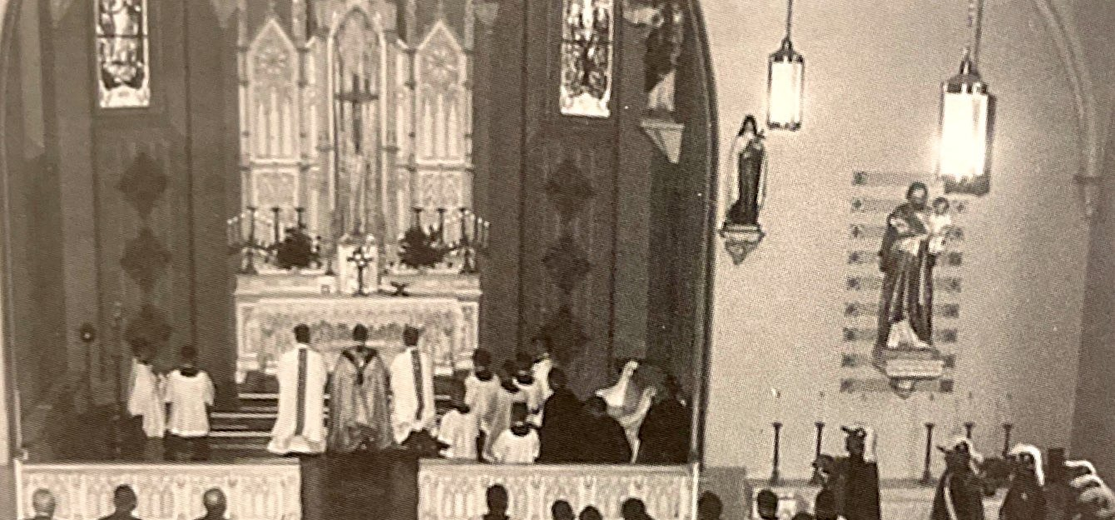
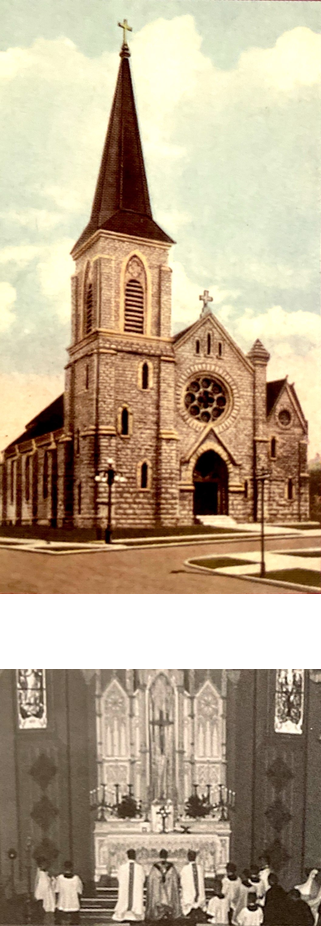
Some time in the year 1854, a Father Sullivan came from Aurora to offer Mass in the farm home of John Lonergan, east of the village of Batavia. A scant dozen Catholics assembled in the Lonergan home for this first Mass. Undaunted by the small congregation, Father Sullivan persevered in his missionary effort. Within a few months, he had rented a single room in a block on Batavia Avenue immediately north of Wilson Street, and so slight was the increase of Catholics that this small chapel was adequate for six years.
The care of the small mission was assumed by Father Patrick O'Dwyer of St. Charles. In 1860, Father 'Dwyer had inspired his small flock with courage to purchase the former Congregational Church which adjoined the chapel then being used.
Whether Father O'Dwyer had overestimated the resources of his Batavia congregation or whether their own desire for a church had carried them Beyond their financial depth, is a matter of record that the people were threatened with the loss of their church because of their failure to meet the payments. In this crisis, Owen Kavanaugh and John Findley rose as leaders in a determined effort to save the church. They went from home to home receiving the pitifully small donations which the impoverished Catholics were able to give. Kavanaugh himself gave up a sorely needed overcoat to help supply the need. Despite their sacrifices, the Catholics were unable to raise the sum required, and the church was saved only through additional help given by generous non- Catholics.
Marriages, from 1857, were recorded in a special register for Batavia. Baptisms, however, were recorded in the parish register of St. Patrick Church, St. Charles, until February of 1866.
It is with the arrival of Father Michael Pendergast, O.P. (1870-1875) as the first resident pastor of St. Charles that the history of Holy Cross Parish properly begins.
Father Pendergast must have been hopeful of the growth of the Batavia mission for he purchased the Kemp property on the east side at the corner of Wilson and Van Buren, a commanding site in that day, and soon left St. Charles to take up residence in Batavia. St. Charles now became the mission from Batavia and not long after Turner Junction, now West Chicago, was placed in the care of the pastor of Batavia. The territory served by the pastor of Holy Cross then embraced the present areas of the parishes in Batavia, St. Charles, Geneva and West Chicago. St. Patrick Parish in St. Charles soon regained independent status but West Chicago remained a mission of Batavia for many years, in fact, it wasn't until the coming of Father George Ratz (1893-1907) that West Chicago was severed and Elburn became the mission of Batavia.